Taking the Assessment
The TruthVouch AI Maturity Assessment is a structured questionnaire designed to evaluate your organization’s AI governance, technical capabilities, compliance readiness, and operational maturity. Most organizations complete it in 15-30 minutes.
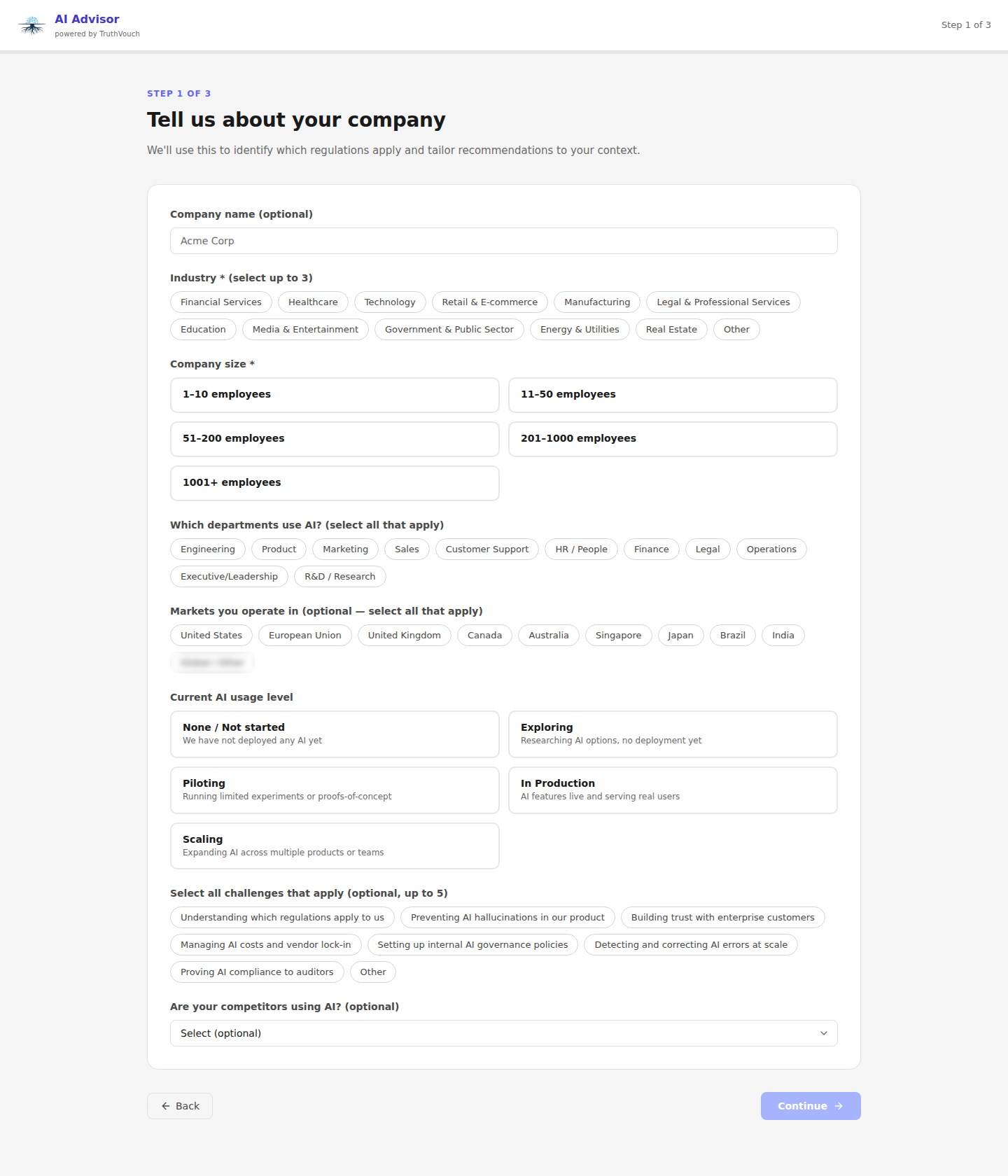
Before You Start
Who Should Take It?
The assessment is designed for:
- Executives (CTO, Chief Governance Officer, AI Lead)
- Governance teams (Risk, Compliance, Legal)
- Technical leads (AI/ML engineering, Data)
Best practice: Gather input from 2-3 stakeholders across departments. You can save progress and return later to add more detail.
Preparation
- Gather docs: Have your AI governance policy (if any), vendor agreements, and incident logs handy
- Schedule time: 15-30 minutes uninterrupted
- Team access: Invite governance stakeholders to the same workspace for collaboration
- Optional: Review the scoring dimensions in advance to align on answers
Starting the Assessment
Step 1: Choose Assessment Type
| Type | Duration | Use Case | Repeat Frequency |
|---|---|---|---|
| Quick | 10 min | Baseline overview | Every 6 months |
| Standard | 20 min | Comprehensive evaluation (recommended) | Every 12 months |
| Detailed | 45 min | Deep audit; all sub-questions | Annual or by request |
Recommendation: Start with Standard (20 min). If areas need depth, expand to Detailed later.
Step 2: Workspace Context
Specify:
- Organization: (auto-selected from your workspace)
- Department: (optional — Governance, Technology, Finance, etc.)
- Respondents: Add other team members taking the assessment
- Assessment date: Today’s date (or choose historical date for retrospective)
Click Start Assessment.
Question Types
The assessment uses three question formats:
1. Yes/No/Partial (with Follow-Up)
Example: “Does your organization have a formal AI governance policy?”
- No (0 points): We don’t have a formal policy
- Partial (0.5 points): We have a draft or informal process
- Yes (1 point): We have a documented, implemented policy
If you answer “Partial” or “Yes”, a follow-up question appears:
- “When was it last reviewed?” (to assess if current)
- “Who owns it?” (to assess accountability)
2. Multiple Choice with Ranking
Example: “Which of these AI monitoring capabilities do you have? (Select all that apply)”
- ☐ Real-time hallucination detection
- ☐ Cross-checking against knowledge base
- ☐ Bias detection
- ☐ Manual review process
- ☐ None of these
More items selected = higher score. Comprehensive monitoring scores highest.
3. Maturity Level / Frequency
Example: “How often do you conduct risk assessments on new AI systems?”
- Ad-hoc (as problems arise)
- Annually
- Quarterly
- Monthly
- Continuous/real-time
Higher frequency = higher maturity.
Working Through Sections
The assessment is organized into 4 main sections:
Section 1: Governance & Strategy (7-8 min)
Questions about your AI governance framework, policies, risk management, and vendor oversight.
Sample questions:
- Does your org have a formal AI governance policy?
- Who has executive accountability for AI governance?
- Do you have a risk assessment process for new AI systems?
- Do you require AI governance clauses in vendor contracts?
Section 2: Technical Readiness (5-6 min)
Questions about monitoring, detection capabilities, data quality, and system architecture.
Sample questions:
- What’s your current hallucination detection capability? (Manual review → Continuous automated)
- Do you monitor cross-checks against a knowledge base?
- What % of critical facts are documented (Truth Nuggets)?
- Do you have centralized logging of AI interactions?
Section 3: Compliance & Ethics (5-6 min)
Questions about regulatory readiness, bias mitigation, transparency, and data privacy.
Sample questions:
- Have you mapped your compliance obligations (SOX, HIPAA, GDPR, EU AI Act)?
- Do you assess training data for bias?
- Do you disclose AI usage to customers/users?
- Do you have a data privacy policy covering LLM interactions?
Section 4: Operations & Culture (2-3 min)
Questions about team skills, incident response, and cross-functional alignment.
Sample questions:
- Do you have dedicated AI governance/risk staff?
- Do you have an incident response plan for AI failures?
- How often does your AI governance team meet? (Leadership, Legal, Tech)
Saving Your Progress
Auto-Save
TruthVouch automatically saves your responses every 30 seconds. You can close your browser anytime and return later to resume.
Checkpoints
After each section, you’ll see: “Progress: 25% → Next: Technical Readiness”
Click Save & Continue Later to pause and resume:
- Assessment automatically saves
- You’ll receive an email with a resumption link
- Return anytime to complete remaining questions
Collaboration
If multiple team members are responding:
- Invite them to the assessment
- Each person completes independently
- System shows responses side-by-side for comparison
- Resolve conflicts (if answers differ on a key question)
Answering Difficult Questions
”I Don’t Know”
If you’re unsure about a question:
- Ask for clarification — hover over the question mark icon for definitions
- Select “I’m not sure” option (counts as lower score, but registers your uncertainty)
- Assign to team member — if someone else should answer (click “Assign”)
- Mark for follow-up — flag it for discussion later
”It’s Complicated”
Some orgs have partial implementations:
- Partial coverage: “We monitor some AI systems, not all” → Select Partial (0.5)
- In progress: “We’re implementing detection this Q” → Select Partial; add comment
- Legacy systems: “Old systems lack monitoring” → Explain in comment field
Comments are visible to your team and help during remediation planning.
Tips for Accurate Responses
- Be honest — The assessment is confidential and used for planning, not auditing
- Be specific — “We monitor 40% of AI outputs” is better than “We monitor”
- Distinguish plans from reality — Roadmap items aren’t current capabilities
- Account for maturity variations — If governance is strong but ops is weak, reflect that
- Get input — Consult across Governance, Legal, Tech, and Finance teams
Completing the Assessment
Final Review
Before submitting:
- Review unanswered questions (system highlights them)
- See confidence warnings (if you marked “I’m not sure” on key questions)
- Preview your preliminary scores by dimension
- Return to any section to refine answers
Submitting
Click Submit Assessment. TruthVouch automatically calculates and displays:
- Overall AI Maturity Score (0-100)
- Dimension breakdown (Governance, Technical, Compliance, Operations)
- Percentile ranking vs. industry peers (automatically compared)
- Key findings summary (3-5 main insights, auto-generated)
After Completion
Immediate Results
TruthVouch automatically generates:
- Executive Summary (1-page PDF) — ready to share with leadership
- Full Report (20-page PDF) — detailed breakdown by dimension
- Interactive Dashboard — explore scores, comparisons, trends
- Recommendations — automatically prioritized action items based on your results
Next Steps
- Review with your team — Governance + Executives + Tech leads
- Benchmark your scores — See Benchmarks to compare vs. peers
- Prioritize gaps — Focus on high-impact improvements
- Plan actions — Create project roadmap
- Re-assess in 90-180 days — Measure progress
Time Estimates by Section
| Section | Questions | Avg Time | With Collaboration |
|---|---|---|---|
| Governance | 12 | 7-8 min | 10-12 min |
| Technical | 10 | 5-6 min | 8-10 min |
| Compliance | 9 | 5-6 min | 8-10 min |
| Operations | 7 | 2-3 min | 3-5 min |
| Total | 38 | 20 min | 30 min |
Pro tip: If collaborating across teams, you can each take the assessment independently in 20 min, then align on answers in a 30-min sync.
Assessment Frequency
Minimum Cadence
- Initial assessment: Before implementing any AI governance (baseline)
- Follow-up: 90-180 days after your first improvements
- Annual review: Reassess at least yearly to track progress and handle new regulations
Best Practice
- Quarterly light checks: “Quick” assessment (10 min) to stay on top of maturity
- Annual deep dive: “Standard” or “Detailed” assessment for comprehensive evaluation
- After major events: Reassess after hiring, policy changes, or regulatory updates
Tips for Teams
Multi-Team Approach
- Governance team takes the assessment (baseline)
- Tech team provides feedback on Technical Readiness section
- Legal/Compliance validates Compliance section
- Executives review and align on strategy
Documenting Rationale
- Add comments to justify your answers
- Reference policies, incidents, or projects
- This creates audit trail for compliance reviews
Related Topics
- Understanding Scores — How each dimension is calculated
- Benchmarks — How you compare to industry peers
- Improvement Planning — Actions based on assessment results
Next Steps
- Schedule assessment with your team (20-30 min)
- Invite collaborators from Governance, Tech, and Legal
- Complete the assessment using the guidance above
- Review your score and compare to benchmarks
- Plan your improvement roadmap