Generative Engine Optimization (GEO) Overview
GEO is Generative Engine Optimization — the practice of optimizing your website content to be discovered and understood by AI systems like ChatGPT, Claude, and Gemini. It’s SEO for the AI era.
Why GEO Matters
Search engines are being disrupted. 30% of users under 30 now use AI as their first search method instead of Google. If your website isn’t optimized for AI discovery, you’re invisible to a growing portion of your market.
SEO vs. GEO
| SEO | GEO |
|---|---|
| Optimize for search engine crawlers | Optimize for LLM training and inference |
| Goal: rank on first page | Goal: be cited accurately by AI |
| Focus: keywords, backlinks, authority | Focus: factual density, structure, freshness |
| Payoff: clicks from search | Payoff: mentions in AI responses |
GEO doesn’t replace SEO — they complement each other.
The 12 GEO Audit Dimensions
Your website is audited across 12 dimensions that affect how AI systems understand and cite your content:
Content Quality (4 dimensions)
1. Factual Density How many verifiable facts are on your pages? AI systems use facts to answer questions.
Score factors:
- % of paragraphs containing named entities (products, companies, people, dates)
- Use of specific numbers (pricing, customer counts, performance metrics)
- Claims backed by evidence
Example:
- Bad: “We’re great at compliance.” (0 facts)
- Good: “ISO 27001 certified, SOC 2 Type II compliant, GDPR/CCPA ready.” (3 facts)
2. Answer Blocks Do your pages answer common user questions upfront?
Score factors:
- Pages with TL;DR or summary section in first 200 words
- Quick answer to title question in opening paragraph
- FAQ sections with clear Q&A format
Example of good answer block:
Q: What is GEO?A: Generative Engine Optimization is the practice of optimizing website contentfor AI discovery. It involves 12 dimensions including factual density, structure,freshness, and content organization. [Full answer follows]3. Citation Friendliness How easy is it for AI systems to cite your content?
Score factors:
- Specific claims with sources (links or references)
- Dates on all time-sensitive content
- Author attribution where relevant
- Quote-able passages (clear, standalone statements)
4. Content Freshness How current is your website content?
Score factors:
- Last updated date visible
- Publication date for news/blogs
- Product launch dates current
- Feature lists match actual product
Structure & Discoverability (5 dimensions)
5. Heading Hierarchy Does your content have clear structure?
Score factors:
- H1 titles that match page intent
- H2/H3 hierarchy that flows logically
- No skipped heading levels (H1 → H3 skipping H2)
- Headings that answer questions (not just “Overview,” “Details”)
Bad hierarchy:
# ProductsContent about products## Pricing (jumped from H1 to H2)## FAQGood hierarchy:
# AI Governance Platform## How It Works## Products### For Developers### For Enterprises## Pricing## FAQ6. Internal Linking How well are your pages connected?
Score factors:
- Related pages linked contextually
- Anchor text that describes what it links to
- No dead links
- Content clusters (related topics grouped)
7. Structured Data Does your HTML include machine-readable markup?
Score factors:
- Schema.org markup (Organization, Product, FAQPage, etc.)
- Open Graph tags for social sharing
- JSON-LD format (preferred)
Example:
{ "@context": "https://schema.org", "@type": "Product", "name": "AI Governance Platform", "description": "Policy-as-code for LLM enforcement", "price": "2499", "priceCurrency": "USD"}8. Content Renderability Can AI systems understand your page without JavaScript?
Score factors:
- Content visible without JavaScript rendering
- Text not hidden behind interactive elements
- Images have alt text
- Videos have transcripts or descriptions
9. AI Bot Access Can AI systems crawl your website?
Score factors:
- robots.txt allows common crawlers (Googlebot, CCBot, etc.)
- No robots.txt blocking
- No authentication walls on public pages
- Sitemap.xml present and valid
Optimization (3 dimensions)
10. FAQ Presence Do you have FAQ sections?
Score factors:
- FAQ pages or sections on product pages
- 5+ frequently asked questions
- Clear Q&A format
- FAQPageSchema structured data
11. Comparison Tables Do you show how you compare to alternatives?
Score factors:
- Feature comparison to competitors or alternatives
- Product tier comparisons
- Use case guides (when to use which product)
- Pricing tiers clearly displayed
12. Sitemap Presence Is your site structure clear?
Score factors:
- sitemap.xml file present
- robots.txt links to sitemap
- All major pages included in sitemap
- Regular sitemap updates
How GEO Scoring Works
GEO Score = (Content Quality Score × 0.40) + (Structure Score × 0.35) + (Optimization Score × 0.25)Where:
- Content Quality: Average of Factual Density, Answer Blocks, Citation Friendliness, Freshness (each 0-100)
- Structure: Average of Heading Hierarchy, Internal Linking, Structured Data, Renderability, AI Bot Access
- Optimization: Average of FAQ Presence, Comparison Tables, Sitemap Presence
Final GEO Score: 0-100
- 90+: Excellent. AI systems can easily find and cite your content.
- 70-89: Good. Minor gaps in structure or content freshness.
- 50-69: Fair. Significant gaps in one or more dimensions.
- Below 50: Poor. Major work needed across multiple dimensions.
Running a GEO Audit
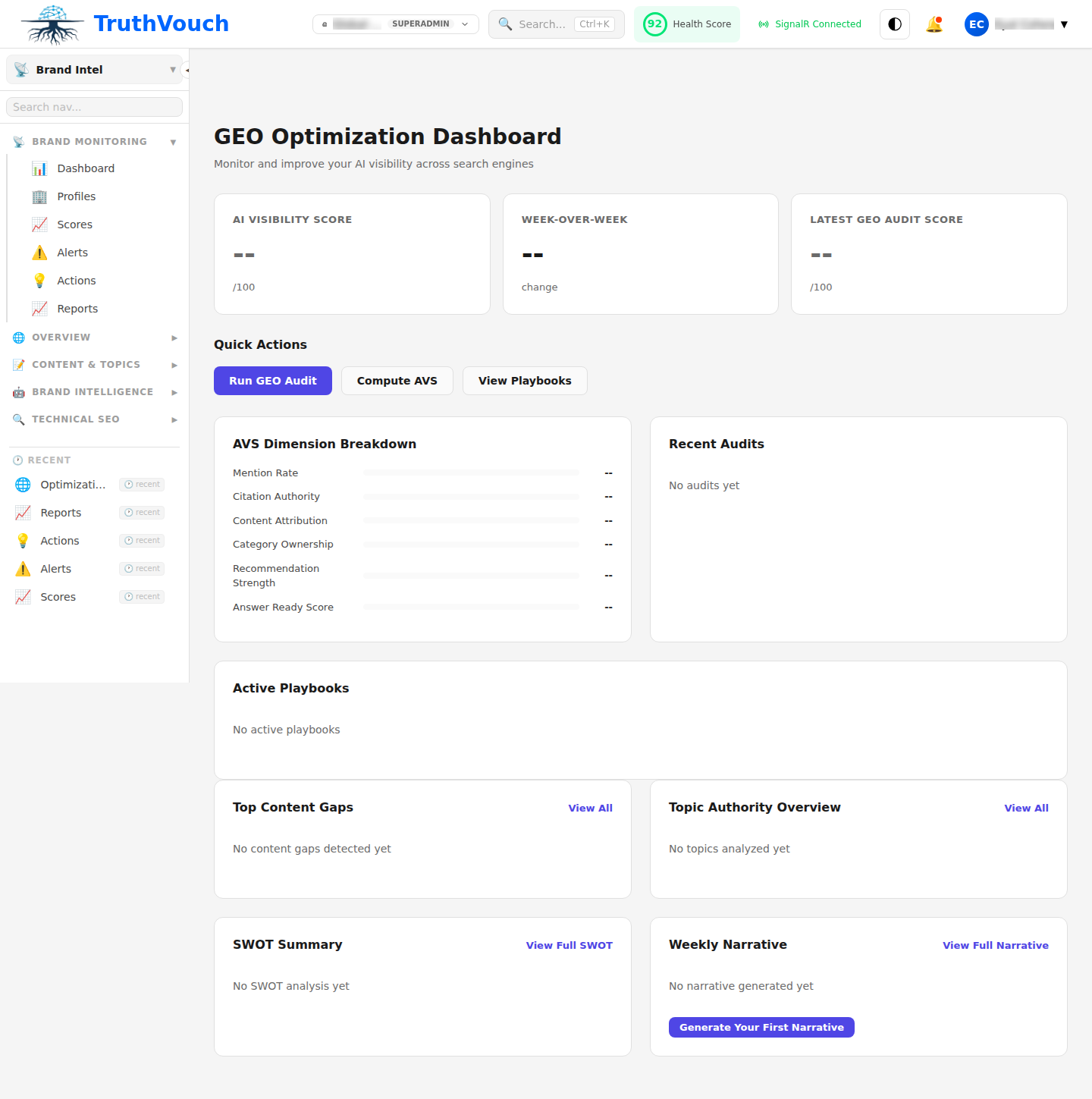
Navigate to Brand Intelligence → GEO → Start New Audit.
- Enter website URL (or subdomain to audit specific section)
- Select dimensions to audit (default: all 12)
- Click Audit
TruthVouch automatically:
- Crawls all accessible pages
- Analyzes each dimension
- Generates per-page and site-level scores
- Prioritizes recommendations by impact
Typical audit time: 5-30 minutes depending on site size
Understanding Your Results
Overall GEO Score
Your site’s score across all 12 dimensions (0-100).
What to do:
- 90+: Maintain and monitor
- 70-89: Focus on top 3-5 recommendations
- <70: Implement all high-impact quick wins, then medium-impact items
Per-Dimension Scores
Breakdown showing which dimensions are weak:
Factual Density: 72/100Answer Blocks: 55/100 ← WeakestCitation Friendliness: 88/100Content Freshness: 92/100Heading Hierarchy: 79/100Internal Linking: 61/100 ← WeakStructured Data: 48/100 ← WeakestContent Renderability: 95/100AI Bot Access: 100/100FAQ Presence: 35/100 ← WeakestComparison Tables: 60/100Sitemap Presence: 95/100Quick Wins
Recommendations that are easy to implement (usually 1-2 hours) and have high impact:
- Add FAQ schema markup
- Improve heading hierarchy on top 3 pages
- Add structured data to product pages
- Create FAQ page
Many quick wins can be auto-fixed from the dashboard.
Medium & Long-term Items
Recommendations requiring more effort:
- Rewrite product descriptions for factual density
- Add internal links between related pages
- Create comparison tables
- Refresh outdated content
Benchmarking Against Competitors
See how your GEO score compares to named competitors (if you’ve set them up):
- Your site: 72/100
- Competitor A: 85/100
- Competitor B: 71/100
- Competitor C: 60/100
This helps you understand if you’re ahead or behind in AI visibility.
When to Re-Audit
- After major website refresh: 1 week after deployment
- After implementing GEO recommendations: 2-3 weeks after changes
- Quarterly: Monthly check to stay current
- After product launch: Audit new pages 1 week post-launch
Next Steps
- Run Your First Site Audit → — Get started with your website assessment
- Page-Level Audits → — Drill into individual page performance
- GEO Recommendations → — Understand action items
- Auto-Fix Quick Wins → — Implement fixes in minutes
- GEO Scoring Deep Dive → — Understand the math