Brand Accuracy Score
Your Brand Accuracy Score (0-100) is the single most important metric in Brand Intelligence. It tells you, at a glance, how accurately AI engines represent your brand.
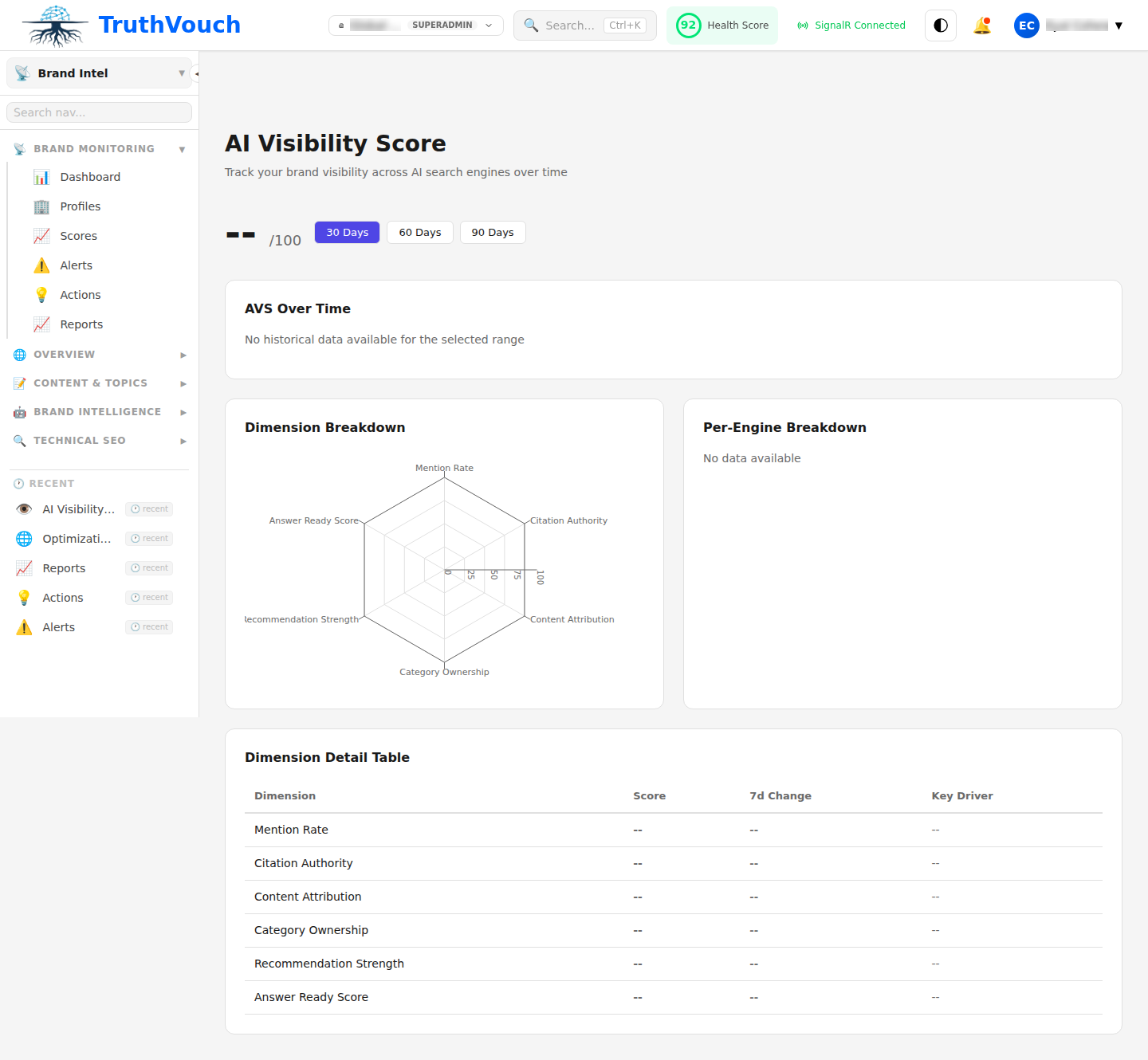
What It Measures
The Brand Accuracy Score aggregates accuracy across all monitored AI engines and all your truth nuggets.
Brand Accuracy Score = Average of all per-engine accuracy scoresWhere each per-engine accuracy score is:
Per-Engine Score = (Correctly verified claims / Total claims in response) × 100Example Calculation
Suppose you have these truth nuggets:
- “Founded in 2020”
- “Serves 500+ enterprise customers”
- “Offers 3 product tiers”
- “HQ in San Francisco”
- “CEO is Jane Smith”
ChatGPT is asked “Tell me about [company]” and responds:
“Founded in 2019, now serving over 400 customers. They offer multiple product tiers. Based in San Francisco. CEO Jane Smith.”
Scoring:
- “Founded in 2019” vs. “Founded in 2020” = INCORRECT (off by 1 year)
- “400 customers” vs. “500+ customers” = INCORRECT (outside range)
- “Multiple product tiers” vs. “3 tiers” = CORRECT (semantically equivalent)
- “San Francisco” vs. “San Francisco” = CORRECT
- “Jane Smith” vs. “Jane Smith” = CORRECT
ChatGPT accuracy = 3/5 = 60%
If Gemini scored 85%, Claude 90%, and Perplexity 75%, then:
Brand Accuracy Score = (60 + 85 + 90 + 75) / 4 = 77.5%
Scoring Rules
What Counts as “Correct”
- Exact match: “Founded in 2020” matches “Founded in 2020”
- Semantic equivalence: “Serves enterprises” matches “Serves 500+ enterprise customers”
- Partial match: “In San Francisco” matches “HQ in San Francisco”
- Range/approximation match:
- “Around 500 customers” matches “500+ customers”
- “Founded in early 2020” matches “Founded in 2020”
- “500-600 customers” matches “500+ customers”
- Passive voice: “Was founded in 2020 by Jane” matches “Jane founded in 2020”
What Counts as “Incorrect”
- Factually wrong: “Founded in 2018” vs. “Founded in 2020”
- Outdated: “Serves 100 customers” vs. “Serves 500+ customers” (when said 2 years after growth)
- Contradicted: “Competitors include X” vs. your truth nugget “We don’t compete with X”
- Missing context: “Just a startup” vs. “Profitable for 3 years”
- Magnitude errors: “Founded 50 years ago” vs. “Founded in 2020”
What Counts as “Neutral” (Unscored)
Some claims don’t affect your accuracy score:
- Opinions: “We think they’re innovative” (opinion, not a fact)
- Predictions: “They might expand to Europe” (prediction, not current fact)
- Generic praise: “Good product” (subjective, not verifiable)
- Out of scope: “Elon Musk mentioned them once” (not in your truth nuggets, so not scored)
Factors That Affect Your Score
1. Website Content Currency
Your website is the primary source for AI training data. If your website is outdated, AI scores will be low.
Common issues:
- “Serving 100 customers” on website but you now have 500
- Old press release at top of blog
- “Hiring” page with old job postings
- Outdated product screenshots
Action: Audit your website for outdated content. Update these high-visibility pages:
- Homepage
- About/Company page
- Product pages
- Leadership bios
2. Truth Nugget Representation
A truth nugget only helps your score if it’s actually on your website and AI can find it.
Bad truth nugget: “We have 47 patents”
- Where is this stated on your website? If nowhere, AI won’t know it.
- Result: Low score because AI can’t find this fact.
Good truth nugget: “We have 47 patents”
- Displayed on homepage: “Backed by 47 patents in AI security”
- Mentioned in press release: “Patents awarded in 2023, 2024”
- Linked from Patents page with details
- Result: High score because AI can easily find and verify it.
Action: Review your truth nuggets and ensure each one appears on your website in a clear, prominent way.
3. Competing Information
Sometimes outdated or incorrect information about your brand exists elsewhere in AI training data.
Example: An old TechCrunch article from 2018 says “Founded in 2018” but you were actually founded in 2020. AI training data includes both sources. When queried, the model might reference the old article.
Why this matters:
- Old Wikipedia entries
- Archived blog posts
- News articles with errors
- Competitor websites with inaccurate info about you
Action: You can’t delete these sources, but you can:
- Create newer, more authoritative sources that contradict the old info
- Link prominently to the correct information from your website
- Submit corrections to Wikipedia (if you’re listed)
4. AI Model Training Schedule
Each AI model has different training data and different update schedules.
| Model | Typical Update | Data Cutoff |
|---|---|---|
| GPT-4o | Every 3-4 months | April 2024 |
| Claude 3.5 | Every 3-6 months | April 2024 |
| Gemini 1.5 | Every 2-3 months | Late 2023 |
| Perplexity | Real-time (web search) | Today |
| Copilot | Every 1-2 months | Varies |
If you update your website today, don’t expect all models to reflect the change immediately. ChatGPT might take 3-4 months. Perplexity will know within days.
5. Query Ambiguity
Vague prompts produce lower scores because AI must guess what you’re asking.
Example:
- Bad query: “Tell me about [company]” (AI might list competitors, history, irrelevant facts)
- Good query: “What products does [company] offer?” (specific, AI knows what you want)
Brand Intelligence uses specific, structured queries to minimize this effect.
Interpreting Your Score
90-100: Excellent
AI engines have accurate, current information about your brand. No action needed except maintaining currency.
Next steps:
- Continue quarterly updates to truth nuggets
- Monitor for narrative drift
- Stay ahead of product/market changes
70-89: Good
AI engines mostly have you right, with some gaps or outdated info.
Next steps:
- Review the “Incorrect Claims” section of your dashboard
- Check if those facts are clearly on your website
- Add or rewrite content where facts are missing
- Re-run audit in 2 weeks after changes go live
50-69: Fair
Significant accuracy gaps. Multiple engines have outdated or wrong information.
Likely causes:
- Website content is outdated
- Truth nuggets aren’t well-represented on your website
- Competing information exists in training data
Action plan:
- Audit your website for currency (use GEO recommendations)
- Rewrite top 5 “missing information” claims into your website
- Add truth nuggets for recent changes
- Re-audit weekly until you reach 70+
Below 50: Critical
Severe representation gaps. Major action needed.
Action plan:
- Schedule immediate website audit
- Update top 10 inaccuracies yourself
- Implement GEO quick wins (structured data, answer blocks, FAQ markup)
- Consider hiring content specialist if in-house team is stretched
- Monitor daily until you reach 50+, then weekly
How to Improve Your Score
Fastest Impact (1-2 weeks)
- Fix outdated website content — Update “About,” “Products,” “Leadership” pages with current info
- Add missing facts to website — If a truth nugget exists but isn’t on your website, add it
- Implement GEO quick wins — Structured data, answer blocks, FAQ schema (auto-fixable from dashboard)
Medium-term (2-4 weeks)
- Comprehensive website refresh — Rewrite product descriptions, feature lists, pricing pages for clarity
- Improve content structure — Add headings, subheadings, internal links for AI discoverability
- Publish new content — Blog posts, whitepapers, case studies that reinforce accurate narratives
Long-term (1-3 months)
- Maintain content calendar — Regular updates keep website fresh for both search and AI
- Monitor competitive information — Track if competitors are spreading misinformation
- Quarterly truth nugget reviews — Update nuggets as your business evolves
Score Changes Over Time
Don’t expect overnight improvements. Here’s a realistic timeline:
Week 1: You improve website and deploy GEO fixes
- No change — AI models haven’t re-crawled your site yet
Weeks 2-4: AI models start seeing your changes
- Perplexity +5-10 points (real-time web search)
- Gemini +2-3 points (next weekly crawl)
- ChatGPT no change yet (training data is static between model updates)
Month 2-3: As AI models are updated
- ChatGPT +5-15 points (next model training cycle)
- Claude +5-15 points (next training cycle)
Final state (3-4 months): All models converge to reflecting your current website
Common Misconceptions
”My score is low, so people think we’re X”
Not necessarily. Your score measures accuracy among AI systems. Real people might have different perceptions. Use this alongside customer research.
”I can’t improve my score without hiring a marketing team”
False. Most score improvements come from updating existing website content (1-2 day effort) and adding missing facts (2-3 days). You don’t need new content, just clearer content.
”If I improve my website, my score immediately goes up”
Not true. There’s a lag. Perplexity responds in days. ChatGPT takes months. Plan for a 2-4 week improvement curve.
”The score is meaningless if competitors spread misinformation”
Partially true, but you can control 70% of your score. Focus on what you can control: your website.
Next Steps
- Improve Your Score via GEO → — The proven path to higher accuracy
- Dashboard Deep Dive → — See your score in context
- Monitor AI Engines → — Understand why engines differ
- Set Up Alerts → — Get notified of score changes