Compliance AI Overview
TruthVouch Compliance AI transforms how organizations demonstrate and maintain compliance with AI regulations. Instead of months of manual audits and spreadsheets, you map your AI systems to regulatory requirements in minutes — continuously auto-discovering new systems, collecting real control evidence from your infrastructure, and generating audit-ready reports in under 20 minutes.
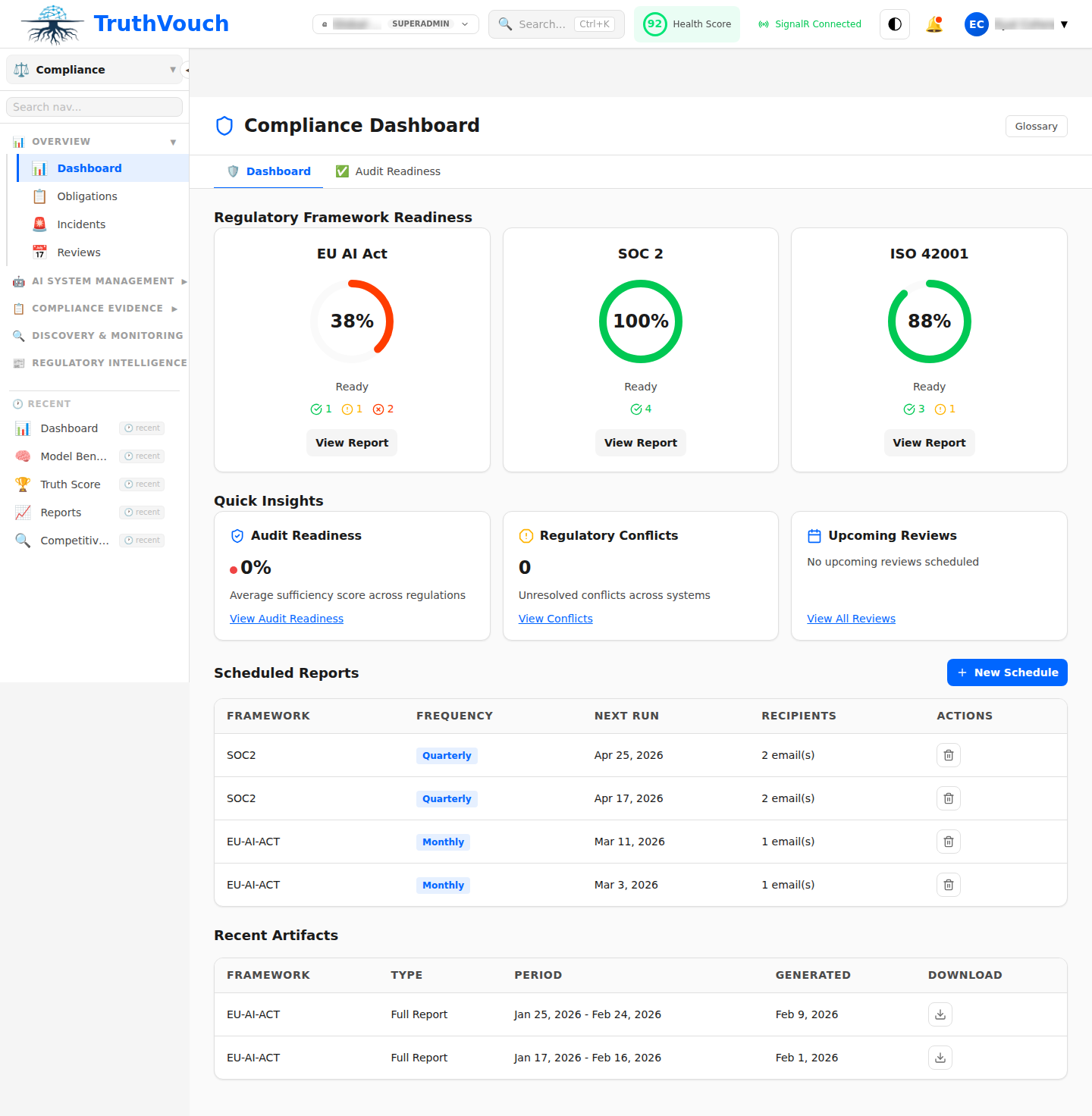
The Compliance Challenge
Modern AI compliance is complex. Your organization must demonstrate adherence to dozens of overlapping regulations:
- EU AI Act — 37 articles covering risk classification, documentation, and incident reporting
- GDPR — Data protection, DPIAs, breach notification, and data subject rights
- ISO 42001 — AI Management System certification and controls
- SOC 2 — Trust Services Criteria adapted for AI systems
- NIST AI RMF — Govern, Map, Measure, Manage framework
- HIPAA, CCPA, LGPD, AIDA — Regional health, privacy, and sector-specific rules
- 22+ other jurisdictions — UK, China, Brazil, Canada, Japan, Australia, and more
The problem: your compliance team manually tracks AI systems in spreadsheets, relies on developers to self-report, collects evidence piecemeal, and scrambles before audits. Meanwhile, new shadow AI systems proliferate unseen, and regulators push for stricter documentation.
How TruthVouch Compliance AI Solves It
Compliance AI automates the entire lifecycle: discover, map, assess, remediate, and prove.
1. Auto-Discovery of AI Systems
Your organization likely has more AI systems than you realize. Shadow AI — uncatalogued ChatGPT instances, copilot tools, vendor AI — escapes compliance entirely.
Compliance AI scans your infrastructure to auto-discover:
- Internal LLM integrations (via logs and code analysis)
- Third-party AI tools (via SaaS inventory and network signatures)
- Employee AI usage (via Slack, email, VPN metadata)
- Vendor AI systems (via integration APIs)
Discovery surfaces 3-5x more systems than teams self-report. Each system is automatically classified by risk level (unacceptable, high, limited, minimal) using EU AI Act criteria.
2. Framework Mapping in Minutes
Once systems are inventoried, Compliance AI maps each to applicable frameworks. A single generative AI system must address requirements from:
- EU AI Act (if your users are in the EU)
- GDPR (for data processing)
- ISO 42001 (if you pursue certification)
- NIST AI RMF (if you work with US government)
- SOC 2 (if you’re SaaS)
- Sector rules (HIPAA for healthcare, FINRA for fintech, etc.)
Instead of manual spreadsheet mapping, Compliance AI computes jurisdiction relevance based on your operating regions, generates requirement-to-control maps automatically, and tracks which controls apply to which systems.
3. Auto-Generated Model Cards & Annex IV Docs
EU AI Act Article 73 and ISO 42001 require detailed system documentation. Compliance AI auto-generates:
- Model Cards — System description, training data, performance metrics, intended use, limitations, and known risks
- Annex IV Documentation — High-risk AI system documentation per EU AI Act Annex IV
- Risk Assessment Reports — Bias, fairness, safety, and security analysis
- DPIA Documents — Data Protection Impact Assessments per GDPR Article 35
All generated in PDF and JSON formats, customizable by your team, and audit-ready.
4. Live Control Evidence from 16+ Connectors
The most time-consuming compliance task: proving controls are working. Compliance AI connects to your infrastructure to pull live evidence:
Cloud & Hosting: AWS, Azure, GCP, Kubernetes Development: GitHub, GitLab, Jira, Azure DevOps IT & Access: Okta, Active Directory, 1Password, Vault Observability: Datadog, Dynatrace, CloudWatch, Prometheus Chat & Notifications: Slack, Teams, Discord GRC & Ticketing: ServiceNow, Jira, Compliance.ai
Each control is evaluated automatically: policy logs, deployment records, access logs, encryption status, and training completion rates flow directly from your systems into compliance reports.
5. Training Program Management
ISO 42001, SOC 2, and most regulations require documented AI training for staff. Compliance AI manages:
- SCORM/xAPI LMS integration — Upload training packages, auto-track completion
- Per-role curriculum — Assign different training to developers, compliance teams, executives
- Certificate generation — Auto-issue training certificates for audit evidence
- Completion tracking — Dashboard view of team progress, auto-reminders for overdue staff
Training completion automatically becomes evidence for compliance controls.
6. Incident Management & Authority Notifications
When incidents happen, regulators expect rapid response. Compliance AI provides:
- 14 pre-built breach response playbooks — EU AI Act Article 73, GDPR Article 33, ISO 42001, SOC 2, HIPAA, CCPA, and cross-framework scenarios
- Authority notification dispatch — Auto-draft notifications to authorities; 72-hour and 15-day deadline tracking with alerts
- Timeline tracking — Chronological incident record with evidence attachment
- Notification status — Confirm delivery to regulators, track follow-ups
7. Regulatory Intelligence Feed
Regulations change constantly. Instead of manually monitoring 40+ frameworks, Compliance AI delivers:
- Daily AI-triaged feed — Regulatory changes, enforcement actions, and guidance from 22 jurisdictions
- Filtered by your profile — Only changes relevant to your systems, regions, and industry
- Horizon scanning — Predictive impact analysis: which regulations will affect you in the next 6-12 months
- FAQ bot — RAG-powered answers over all frameworks, with cited article references
8. Audit-Ready Reports in 20 Minutes
Generate executive-grade reports in minutes, not months:
- Compliance status dashboard — Scores per framework, gap counts, control status (Pass/Fail/Partial/N/A)
- Evidence inventory — All controls mapped to collected evidence with chain-of-custody
- Gap remediation plan — Prioritized gaps with auto-generated remediation tasks
- Board-ready narrative — Risk summary, key findings, and strategic recommendations
- Auditor exports — OSCAL format, NDJSON, Jira/ServiceNow integration
Core Capabilities at a Glance
| Capability | What It Does | Benefit |
|---|---|---|
| Auto-Discovery | Scan infrastructure for all AI systems | 3-5x more systems found than self-reported |
| Framework Mapping | Connect systems to 55+ regulations | One control, multiple framework requirements |
| Model Cards | Auto-generate system documentation | EU AI Act Article 73 & ISO 42001 ready |
| Live Evidence Collection | Pull controls from 16+ infrastructure connectors | Real-time proof controls work |
| Training Management | SCORM/xAPI integration, completion tracking | Audit-ready training evidence |
| Incident Management | Playbooks, authority notifications, timeline | 72-hour GDPR response deadline met |
| Regulatory Intelligence | Daily AI-triaged feed, horizon scanning, FAQ bot | Stay ahead of regulatory changes |
| Audit Reports | Compliance status, gap analysis, evidence mapping | 20-minute audit readiness |
| Policy Exceptions | Request/review/approve workflow with expiry | Documented deviations from policy |
| Breach Response | 14 pre-built playbooks, customizable | Fast incident response, authority notification |
| Trust Center | Customer-facing compliance dashboard | Customer confidence, sales enablement |
| Multi-Format Export | OSCAL, NDJSON, Jira, ServiceNow, GRC | Integration with existing tools |
Frameworks Covered
EU & UK: EU AI Act (37 articles), GDPR, UK AI Safety, UK GDPR Global: ISO 42001, NIST AI RMF, SOC 2 Type II Healthcare: HIPAA, FDA AI guidance Privacy: CCPA, LGPD (Brazil), PDPA (Singapore), AIDA (Canada) Regional: China CAC guidelines, Saudi GOSI, UAE regulations, Japan PPC, Australia Privacy Act, India DPDP, South Korea POPIA Sector-Specific: FINRA (fintech), FINMA (Swiss finance), BaFin (German finance), Prudential (insurance)
Tiers & Availability
- Professional — 5 key frameworks (EU AI Act, GDPR, ISO 42001, SOC 2, NIST AI RMF)
- Business — Full suite (55+ regulations, 22 jurisdictions, all capabilities)
- Enterprise — Custom frameworks, dedicated support, on-premises deployment
Next Steps
- New to compliance? Start with Getting Started — register your first AI system in 5 minutes
- Need GDPR compliance? Read DPIA & Algorithmic Assessment for auto-generated impact assessments
- Already compliant? Jump to Auto-Discovery to find shadow AI systems
- Preparing for audit? See Audit-Ready Reports to generate reports in 20 minutes