What Are Truth Nuggets?
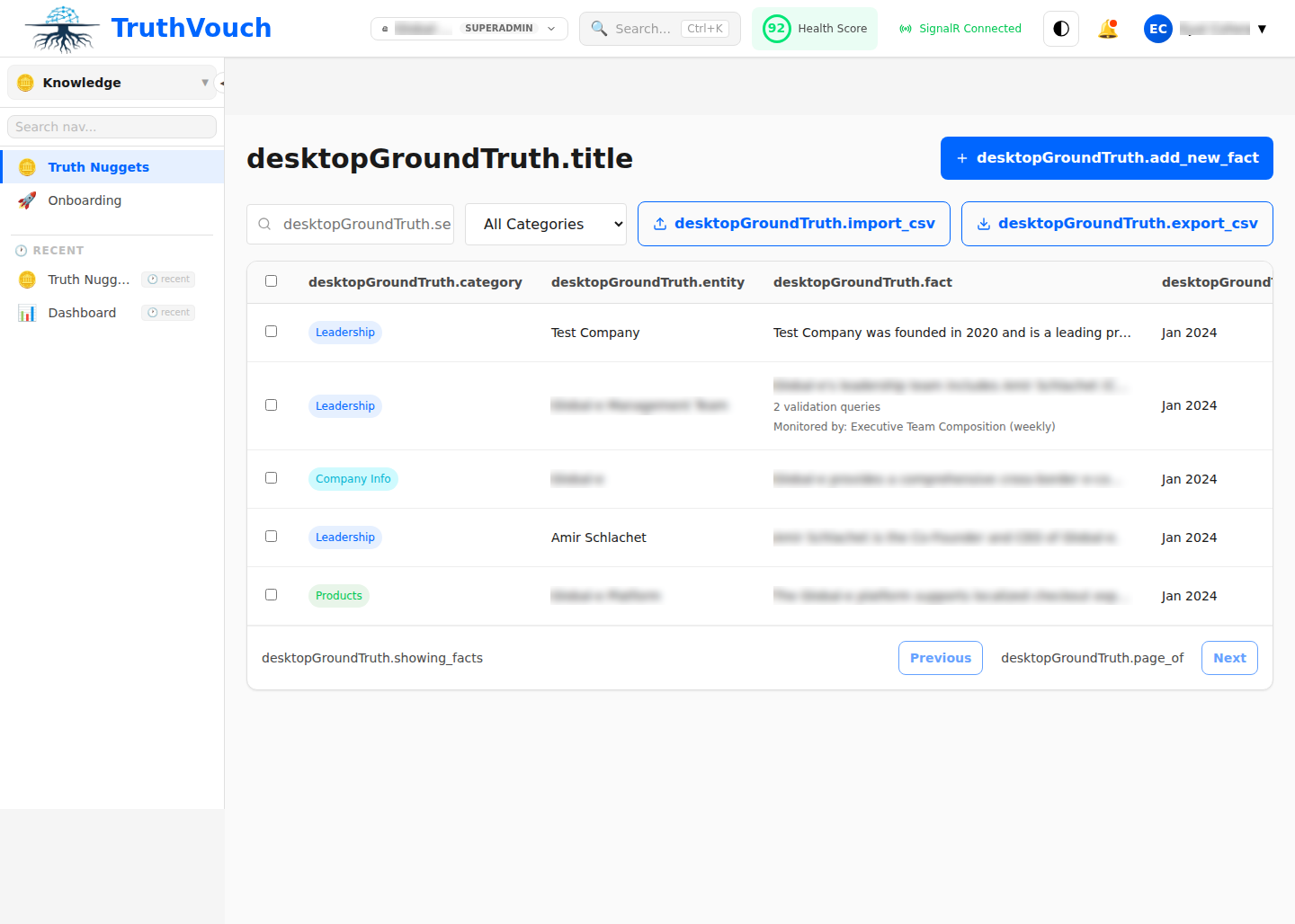
A Truth Nugget is a verified, structured fact about your organization that automatically serves as ground truth for hallucination detection and other products.
Definition
Truth Nuggets are the atomic units of organizational knowledge in TruthVouch. Each nugget is a single, verifiable fact with:
- Fact Text: The statement itself
- Category: Company, Products, Leadership, Financial, Technical, Legal, Competitive
- Confidence Score: 0.0-1.0 (1.0 = absolute certainty, 0.7 = reasonable estimate)
- Source URL: Link to where the fact came from (optional but recommended)
- Expiry Date: When the fact becomes outdated (optional, for time-sensitive info)
Examples
Company Facts
- “TruthVouch was founded in 2024”
- “Headquarters located in San Francisco, California”
- “We are a Series B startup with 120 employees”
Product Facts
- “TruthVouch Shield detects hallucinations with 94%+ accuracy”
- “Shield monitoring costs $349/month starting from Starter tier”
- “API response time is under 200ms at p95”
Leadership Facts
- “Sarah Chen is our CEO and co-founder”
- “Board includes venture leaders from Sequoia and a16z”
Financial Facts
- “Revenue in Q4 2025 was $2.3M (annual run rate $8M)”
- “Funding to date: $15M Series B in March 2024”
Legal & Technical Facts
- “Compliant with EU AI Act Article 37 (transparency)”
- “Data encrypted at rest with AES-256”
- “Processing 5M API requests per day”
Why Categories Matter
Categories organize your Knowledge Base and help with targeted monitoring. Each category groups related facts:
| Category | Use Case | Examples |
|---|---|---|
| Company | General org info | Founding date, HQ, size, mission |
| Products | Product details | Names, pricing, features, launch dates |
| Leadership | Executive information | Names, titles, background |
| Financial | Revenue and funding | Funding rounds, revenue, headcount |
| Technical | Infrastructure claims | API latency, uptime, data handling |
| Legal | Compliance status | Certifications, audit results |
| Competitive | Market positioning | Market share, competitive advantages |
Anatomy of a Good Truth Nugget
Too Vague
“We are a growing company with good technology”
- Not verifiable
- Too broad
- Can’t extract entities
- Useless for detection
Just Right
“TruthVouch processed 2.1B tokens in February 2026”
- Specific and measurable
- Time-bound
- Verifiable via reports
- Contains extractable entity (2.1B)
- Can set expiry (March 2027)
Confidence Scores
Confidence score reflects your certainty about a fact:
| Score | When to Use | Examples |
|---|---|---|
| 1.0 (Absolute) | Verifiable from official sources | Founding date, registered address, published pricing |
| 0.95 | From recent internal data | Current headcount, recent revenue figures |
| 0.9 | Well-documented estimates | Typical API response times, industry rankings |
| 0.8 | Reasonable claims | Forward-looking statements, industry positions |
| 0.7 | Subjective or estimated | ”We have the best UX,” estimated market share |
When Shield detects hallucinations, it weights your confidence score. A contradiction to a 1.0 fact triggers higher alerts than to a 0.7 fact.
When to Set Expiry Dates
Set expiry dates for facts that become outdated:
- Quarterly financials → Expire next quarter
- Product launches → No expiry (evergreen)
- Headcount estimates → Expire in 6-12 months
- Current pricing → Expire if you plan changes
- Certifications → Expire on cert renewal date
When a fact expires, Shield stops using it for detection. You can extend or remove it from the dashboard.
Truth Nugget Lifecycle
Create → Verify → Activate → Monitor → Update/Expire- Create: Enter the fact and metadata
- Verify: Confirm it’s accurate (source URL helps)
- Activate: Start using for detection (immediate)
- Monitor: Shield compares all AI responses against it
- Update: Modify if facts change, or let it expire
Next Steps
- Creating Truth Nuggets — Step-by-step guide
- Best Practices — What works at scale
- Categories & Organization — Organizing your nuggets