How Cross-Checks Work
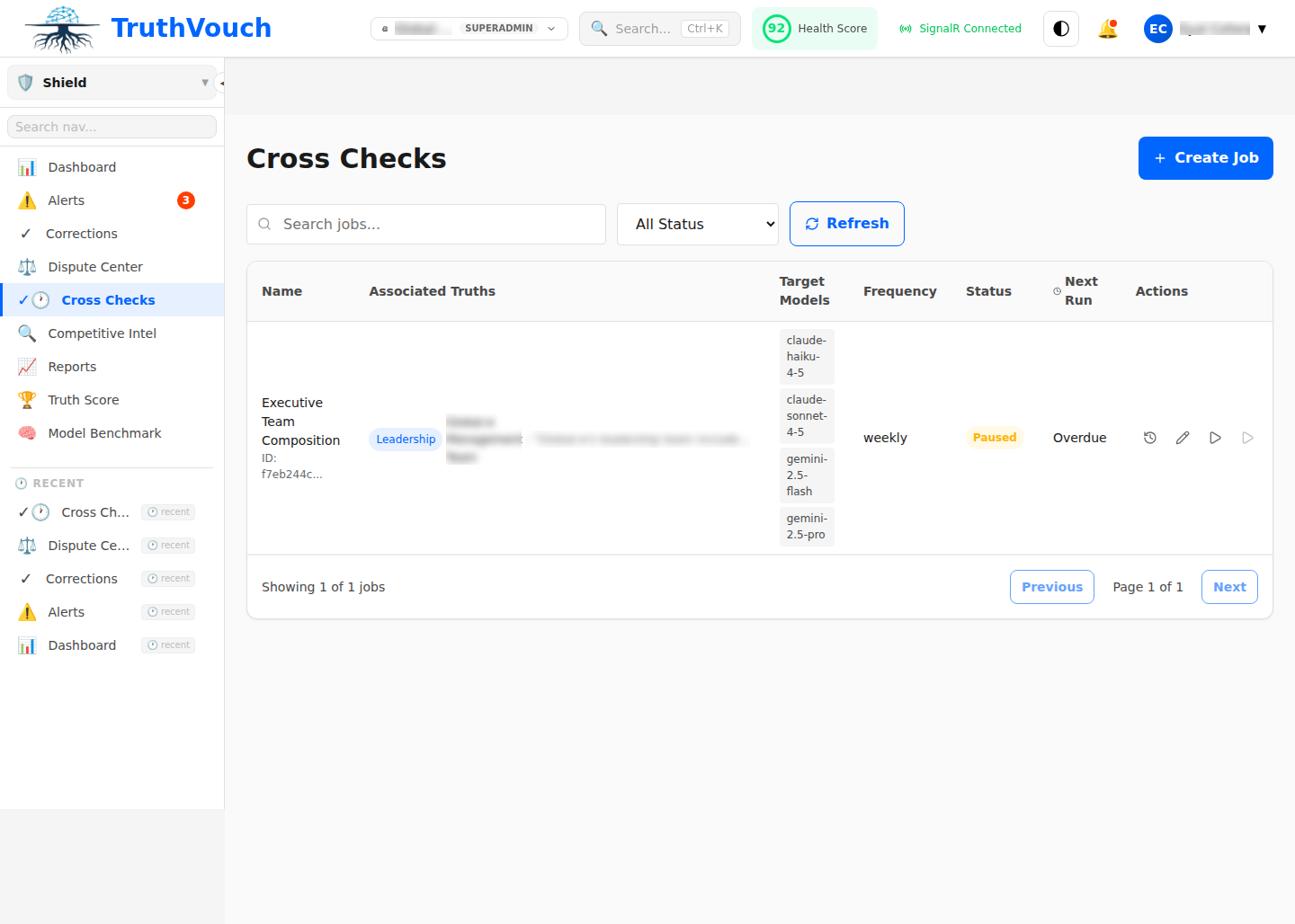
A cross-check is the core operation of Shield. It automatically queries an AI engine about your organization, extracts information from the response, and compares it to your Truth Nuggets to score accuracy.
The Process
Shield runs cross-checks in six steps:
Step 1: Generate Query
Shield automatically creates a natural-language question based on a Truth Nugget.
Example Truth Nugget:
- Fact: “TruthVouch Shield detects hallucinations with 94% accuracy”
- Category: Products
Auto-generated Queries (varies each time):
- “What is TruthVouch Shield and how accurate is it?”
- “Tell me about TruthVouch’s hallucination detection capabilities”
- “How does TruthVouch measure detection accuracy?”
Query variation prevents AI engines from memorizing responses. Shield automatically uses templates and randomization to generate natural-sounding questions.
Step 2: Query AI Engine
Shield automatically sends the query to the AI engine and collects the response.
Example: Send to ChatGPT:
User: "What is TruthVouch Shield and how accurate is it?"
ChatGPT: "TruthVouch Shield is a hallucination detection platformthat monitors AI systems for inaccuracies. The company claimsdetection rates above 90%, and it integrates with major LLMproviders like OpenAI and Anthropic."
Response is logged with:
- Full text
- Engine and model
- Timestamp
- Latency
- Any errors or API issues
Step 3: Named Entity Recognition (NER)
Shield automatically extracts entities (numbers, names, dates, products) from the AI response.
Example response:
"TruthVouch Shield is a hallucination detection platform..."Extracted entities:
- Organization: “TruthVouch”, “OpenAI”, “Anthropic”
- Product: “TruthVouch Shield”
- Percentage: “90%”, “above 90%”
- Type: “hallucination detection platform”
NER identifies what the AI said, not whether it’s right or wrong — just what was stated.
Step 4: Natural Language Inference (NLI)
Shield automatically compares the extracted entities/statements against your Truth Nugget using Natural Language Inference.
Your Truth:
- “TruthVouch Shield detects hallucinations with 94% accuracy”
AI Said:
- “detection rates above 90%”
NLI Decision:
- Is “above 90%” compatible with “94%”? YES (94 is above 90)
- Confidence: 96% (very confident in inference)
- Verdict: COMPATIBLE (or “ENTAILED”)
Another Example:
- Your Truth: “CEO: Sarah Chen”
- AI Said: “founded by David Kumar”
- NLI: CEO ≠ founder, conflict. CONTRADICTION
- Confidence: 99%
- Verdict: CONTRADICTED (or “NEGATED”)
NLI handles paraphrases, synonyms, and logic:
- “Founded in 2024” vs “established in 2024” = COMPATIBLE
- “500+ customers” vs “over 400 customers” = COMPATIBLE
- “Available in 50 countries” vs “Available in North America only” = CONTRADICTED
Step 5: Score & Alert
Shield automatically assigns a truth score (0-100) and decides whether to alert based on your configured thresholds.
Scoring:
- ENTAILED (AI strongly matches truth): 95-100
- COMPATIBLE (AI roughly matches): 80-94
- NEUTRAL (AI doesn’t address the fact): 50-79
- CONTRADICTED (AI conflicts): 20-49
- STRONGLY CONTRADICTED (Clear falsehood): 0-19
Alert Decision:
- Score > 80: No alert (AI is accurate)
- Score 60-80: Medium alert (partial mismatch)
- Score < 60: High alert (serious hallucination)
Thresholds are configurable per account.
Example alerts:
- “ChatGPT says detection is ‘90%+’ (True Score: 88) - No alert”
- “Claude says founded by David Kumar (True Score: 15) - Critical alert”
- “Gemini doesn’t mention founder at all (True Score: 50) - Medium alert”
Step 6: Log & Store
Result is stored in audit trail:
Cross-Check Event├─ Timestamp: 2026-03-14 14:32:10 UTC├─ AI Engine: ChatGPT├─ Model: gpt-4-turbo├─ Truth Nugget: "Shield 94% accuracy"├─ Query: "How accurate is TruthVouch Shield?"├─ Response: "TruthVouch Shield... detection rates above 90%"├─ Entities Extracted: ["TruthVouch", "above 90%"]├─ NLI Result: ENTAILED (96% confidence)├─ Truth Score: 92├─ Alert Triggered: No└─ Status: LoggedNLI Explained
Natural Language Inference (NLI) is the key to Shield’s 94% accuracy.
What is NLI?
NLI determines whether a statement (premise) supports, contradicts, or is neutral to another statement (hypothesis).
| Premise | Hypothesis | NLI Result |
|---|---|---|
| ”TruthVouch was founded in 2024" | "TruthVouch was founded in 2024” | ENTAILED (100% match) |
| “TruthVouch was founded in early 2024" | "TruthVouch was founded in 2024” | ENTAILED (compatible) |
| “TruthVouch was founded in 2023" | "TruthVouch was founded in 2024” | CONTRADICTED (conflict) |
| “TruthVouch is a SaaS company" | "TruthVouch was founded in 2024” | NEUTRAL (unrelated) |
Why NLI vs Keywords?
Keyword matching (naive approach):
- Your truth: “94% accuracy”
- AI says: “above 90%”
- Keyword match: NO (different numbers)
- Alert: FALSE POSITIVE
NLI (Shield’s approach):
- Your truth: “94% accuracy”
- AI says: “above 90%”
- Semantic understanding: “above 90%” includes 94%
- Result: COMPATIBLE, no alert
- Success rate: 94% (Shield’s accuracy)
NLI is semantic; it understands meaning, not just words.
How NLI Learns
Shield uses a fine-tuned NLI model trained on:
- SNLI (Stanford NLI) dataset — 570K examples
- Proprietary hallucination data — 50K+ verified examples
- Your feedback — corrections you approve
Over time, as you use Shield, it learns your organization better.
Entity Extraction
Supported Entity Types
| Type | Examples |
|---|---|
| Organization | TruthVouch, OpenAI, Google |
| Person | Sarah Chen, David Kumar |
| Product | TruthVouch Shield, GPT-4 |
| Location | San Francisco, USA |
| Date | March 2024, Q1 2026 |
| Number | 94%, $349/month, 500+ customers |
| Time Duration | sub-4-second, 15 minutes |
| URL | https://truthvouch.com |
Confidence Scoring
Each extracted entity has a confidence score:
- 95%+ = Very confident extraction
- 85-95% = Confident
- 70-85% = Somewhat confident
- <70% = Low confidence (may be noise)
Low-confidence extractions are handled conservatively in NLI comparison.
How Cross-Checks Are Scheduled
Shield doesn’t run cross-checks continuously. Instead, you set schedules.
Example Schedule:
- ChatGPT: Daily at 2:00 PM UTC
- Claude: Every 6 hours
- Gemini: Hourly (critical facts)
This balances:
- Detection timeliness: Catch hallucinations quickly
- API cost: Avoid excessive queries
- Accuracy: Enough data to spot trends
See Scheduling → for detailed configuration.
Cost & Efficiency
Each cross-check costs:
- One API query to the AI engine (minimal — depends on engine)
- One inference call to Shield’s NLI model (included in subscription)
Example cost: Monitoring 5 AI engines, daily schedule:
- 5 engines × 1 query/day = 5 queries/day
- ~150 queries/month
- For ChatGPT: ~$0.15/month (API cost) + included in subscription
More efficient than hiring people to check what AI says.
Accuracy Limitations
NLI has limits:
Where It’s Excellent (>95%)
- Clear facts (dates, people, numbers)
- Simple statements
- Direct contradictions
Where It’s Good (85-94%)
- Complex claims with multiple entities
- Paraphrases and synonyms
- Approximate numbers (“around 500” vs “500+“)
Where It’s Fair (70-85%)
- Subjective claims (“best in class”)
- Market position
- Indirect implications
Where It Struggles (<70%)
- Sentiment and tone (“loves” vs “likes”)
- Speculation and hypotheticals
- Context-dependent meanings
- Sarcasm
Mitigation: You can adjust truth nuggets to be more specific, improving detection for edge cases.
Monitoring the Process
You can see each step:
Go to: Settings → Audit → Cross-Checks
Choose any cross-check event to see:
- Query generated
- Full AI response
- Entities extracted (with confidence scores)
- NLI reasoning
- Final score and alert decision
Next Steps
- Scheduling Cross-Checks — Configure monitoring
- Interpreting Results — Understand what the numbers mean
- Query Templates — Customize queries